
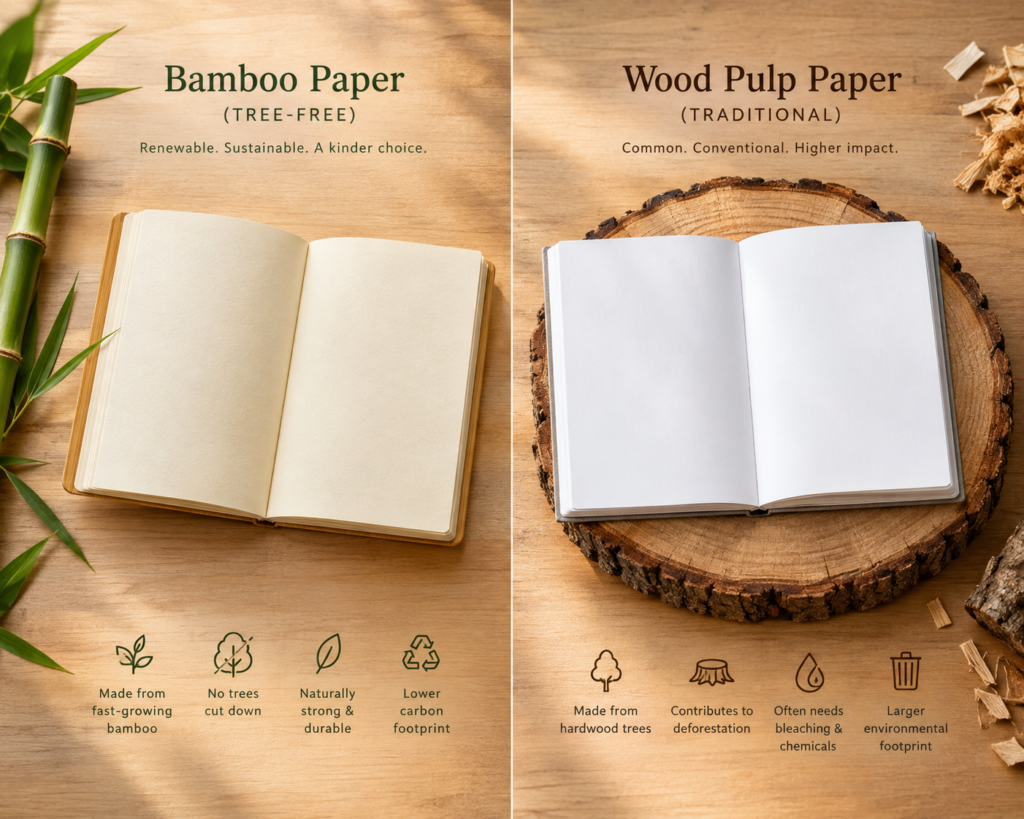
Picture your morning journal, your office notepad, your child’s school notebook — all traced back to a felled tree. That single thought is what’s pushing eco-conscious buyers across India to ask a sharper question: is bamboo paper better than regular paper? Bamboo stationery is a tree-free, rapidly renewable writing material made from fast-growing bamboo pulp instead of hardwood, offering a dramatically lower carbon footprint, natural biodegradability, and zero contribution to deforestation — all while matching the smoothness and durability of traditional wood-pulp notebooks. For India’s growing urban zero-waste movement — from Bengaluru to Lucknow — it’s quickly becoming the obvious upgrade for anyone rethinking their desk.
Is Bamboo Paper Better Than Regular Paper? The Core Differences
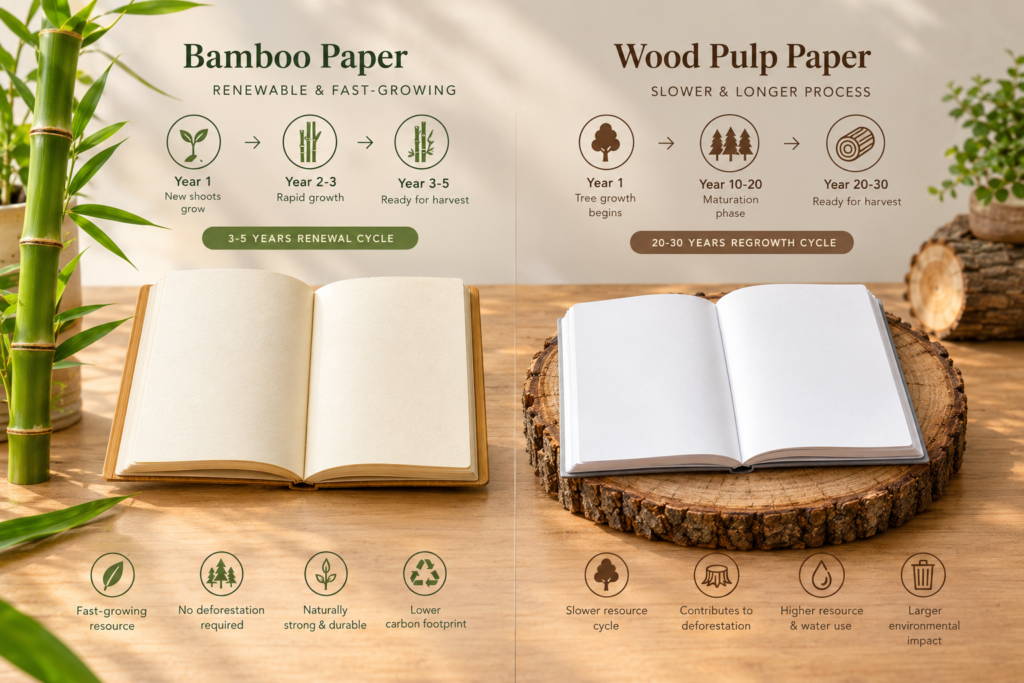
- Growth speed: Bamboo matures in 3–5 years; hardwood trees used for regular paper take 20–30 years to regenerate
- Water usage: Bamboo pulp production typically uses less water per tonne than traditional wood-pulp processing
- Land efficiency: A single bamboo grove yields significantly more usable pulp per acre than an equivalent hardwood forest
- Durability: Bamboo fiber is naturally strong, giving notebooks a smooth, tear-resistant page feel comparable to premium wood-pulp paper
- Renewability: Bamboo regrows from its own root system after harvesting — no replanting required, unlike deforested hardwood land
The Environmental Case: Deforestation, Carbon Footprint, and Bamboo Pulp

- Bamboo absorbs significantly more CO₂ and releases more oxygen per hectare than most hardwood tree species
- Choosing bamboo pulp over wood pulp directly reduces demand on forests already strained by global deforestation
- Bamboo stationery production generally results in a smaller manufacturing carbon footprint compared to virgin wood-pulp paper
- Independent standards like FSC environmental forestry regulations help buyers verify that any wood-based paper they still use is responsibly sourced
- Organizations such as WWF’s research on deforestation impact consistently highlight forest loss as a leading driver of biodiversity decline — a key reason tree-free alternatives matter
Why India’s Urban Eco-Conscious Buyers Are Switching
- Metro cities like Mumbai, Bengaluru, Delhi, and Lucknow are seeing a rise in zero-waste lifestyle communities actively choosing plastic-free, tree-free stationery
- Indian corporates are increasingly requesting sustainable office supplies for ESG reporting and green procurement policies
- Festive and corporate gifting culture in India has shifted toward eco-conscious notebooks and journals over plastic-bound alternatives
- Local eco-retailers and D2C brands are making bamboo stationery more accessible and affordably priced than it was even two years ago
- Explore Earthy Papers’ bamboo notebook collection if you’re part of this shift toward mindful, low-impact stationery
Bamboo vs Other Biodegradable Notebooks: What Sets It Apart
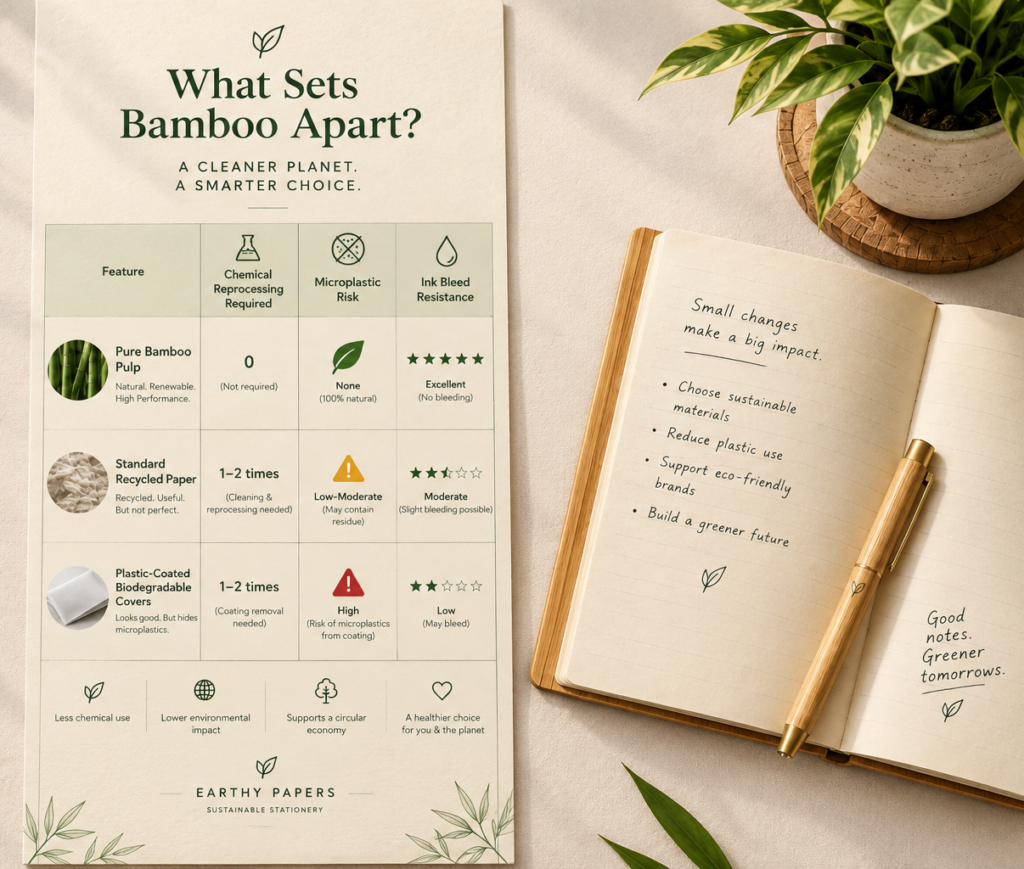
- Unlike some recycled-paper products, bamboo pulp doesn’t require de-inking or chemical-heavy reprocessing
- Bamboo-based biodegradable notebooks break down naturally without leaving microplastic residue, unlike plastic-coated covers
- The natural fiber structure holds ink well, minimizing bleed-through for pens, gel ink, and fountain pens alike
- Bamboo requires no pesticides or fertilizers to grow, unlike many commercial tree plantations
- Browse our tree-free stationery essentials to compare textures and weights before switching your daily notebook
Common Questions Before You Switch
Most wildflower seed paper varieties begin to sprout within 2 to 3 weeks after planting. However, depending on your local climate, soil quality, and the specific seeds used, certain varieties can take up to 6 weeks to fully germinate.
Yes, plantable seed paper absolutely works if planted correctly. To ensure success, you must submerge the paper in water for 2–4 hours first, bury it under a very shallow quarter-inch layer of soil, and keep the dirt consistently damp like a wrung-out sponge.
Soil is significantly better for seed paper because it provides structural nutrients and permanent root anchoring. While a paper towel can sprout seeds, the roots will quickly starve and die unless they are immediately transplanted into loose, fertile potting soil.
High-quality seed paper retains its germination viability for 1 to 2 years. To prolong the life of the embedded seeds, store your stationery in a cool, dark, and completely dry environment away from intense heat or humidity.
No, you do not have to plant the entire sheet. You can easily tear the seed paper into smaller fragments and plant them across multiple small pots. Tearing the paper actual
Make the Switch
If you’ve been asking yourself whether bamboo really is the smarter choice for your desk, the answer increasingly points to yes — lower environmental cost, comparable quality, and a material that doesn’t come at the expense of a forest. Ready to make your notebooks part of the solution? Visit Earthy Papers to explore bamboo and other tree-free stationery built for India’s next generation of conscious writers.
References
- Forest Stewardship Council (FSC). “Responsible Forestry Standards and Chain of Custody Certifications.” Learn how sustainable fiber tracking prevents global deforestation protocols at the official FSC International Resource Center.
- World Wildlife Fund (WWF). “Deforestation Fronts and Global Forest Conservation Research.” Explore the environmental impact data regarding forest habitat losses and tree-free conservation alternatives at the official World Wildlife Fund Forestry Hub.
- Royal Horticultural Society (RHS). “Container Seed Germination and Moisture Management Principles.” Review verified data regarding optimal soil moisture and light exposure metrics for delicate seed propagation at the official RHS Science Repository.